
- Out-of-Stock
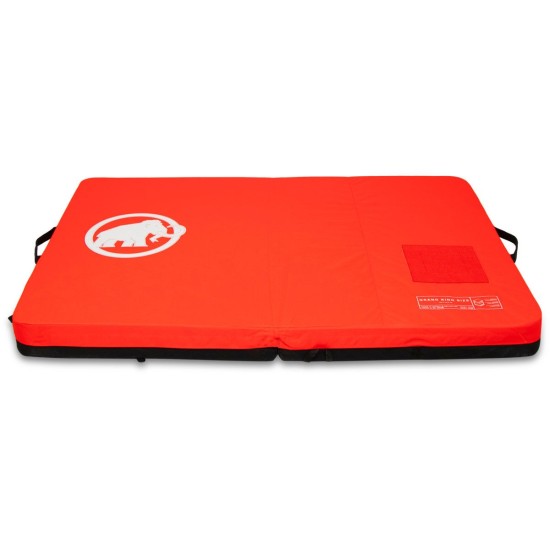

The Mammut Grand King Size Crash Pad offers a large landing surface of 160 x 110 cm and is 12 cm thick. Its construction with three layers of high-quality European foam provides excellent shock absorption for high blocks, dynamic movements, and demanding landings.
The Mammut Grand King Size Crash Pad is a large-format bouldering mat designed to offer an exceptionally wide landing area and high shock absorption capacity. With an open surface of 160 x 110 cm, it provides protection for high boulders, dynamic moves, traverses, and landings where a conventional mat might be too small.
Its interior is made up of three layers of high-quality European foam and reaches a thickness of 12 cm. This construction combines stability and cushioning to distribute impact energy and provide consistent reception.
The 160 x 110 cm landing surface is one of the Mammut Grand King Size's main strengths. Its greater length allows it to cover a wider area under the block and reduces the need for multiple smaller mats for relatively uniform landings.
It is also especially useful during dynamic steps or lateral movements, where it can be difficult to accurately predict the landing point. For landings on rocks, gaps, or uneven surfaces, it can be combined with other crash pads or auxiliary mats.
The interior combines three layers of high-quality European foam to achieve the right balance between firmness and shock absorption. The outer layers help distribute the impact, while the inner layer progressively absorbs the energy generated during a fall.
Its 12 cm thickness provides exceptionally robust protection, making this model suitable for high boulders and demanding landings. The mat's width also allows the impact to be distributed over a larger surface area.
The upper is made from 900 denier recycled polyester. To produce this fabric, Mammut uses textile waste and offcuts from clothing factories. The result is a abrasion-resistant surface designed to withstand frequent use on rock.
The underside uses 1000 denier recycled nylon with a PFC-free DWR water-repellent treatment. This base offers high resistance to contact with rock, soil, and wet ground.
The slightly rounded corners help reduce wear and tear on the most exposed areas of the mat and improve its durability.
The Mammut Grand King Size weighs 9.8 kg, so it incorporates a transport system designed to distribute the load and improve stability during approaches.
Its padded, anatomically shaped shoulder straps are combined with a padded lumbar belt, which allows some of the weight to be transferred from the shoulders to the hips. The belt can be adjusted to two positions to better suit the height of each climber.
The adjustable shoulder straps bring the mat closer to your back and help prevent it from swaying while walking. The chest strap keeps the shoulder straps in the correct position and provides additional stability.
Its six handles allow you to quickly move and reposition the crash pad under the block. This feature is especially useful when you need to adjust its position between attempts or move it a short distance.
It also includes three compression straps with sturdy aluminum buckles. These straps keep the sleeping mat closed and can be connected to form a shoulder strap.
The outer webbing loops offer the possibility of creating a joint transport system with other mats, something especially useful when you need to protect a wide or irregular landing area.
The top surface features an integrated mat for removing dust and dirt from the soles of climbing shoes. Keeping the rubber clean helps maintain better grip on holds and eliminates the need to carry an additional mat.
The Mammut Grand King Size is recommended for climbers who prioritize a large landing surface and high shock absorption. It's a particularly good option for high boulders, long reaches, dynamic moves, and areas where the fall point is difficult to predict.
Its size and weight require a bit more space for transport and storage, but in return, it offers considerably greater coverage than a conventional crash pad. Before climbing, it's important to check that the crash pad is stable and correctly positioned. Using a crash pad reduces the consequences of some falls, but it doesn't eliminate the inherent risks of bouldering.