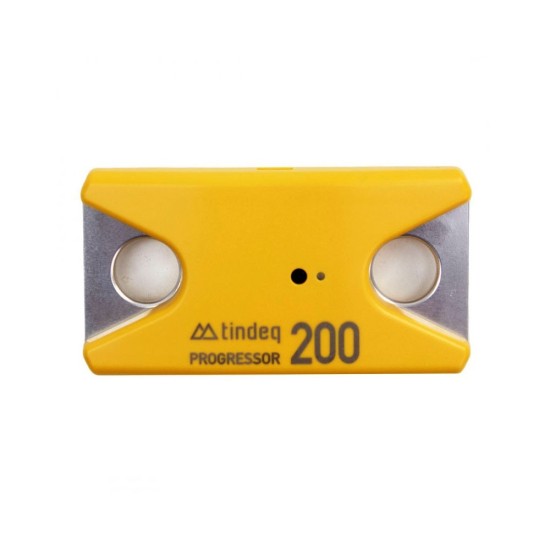


The Tindeq Progressor 200 is the leading force sensor for climbing. Essential for finger strength training and precise load control.
Once you try it, you won't be able to train without it.
The Tindeq Progressor 200 is a Bluetooth strength sensor for climbing designed to accurately measure your finger strength, pulls, and lock-offs. Connect the Tindeq to your phone, hang it on your training board or a quickdraw… and turn any session into an objective performance test.
If you want to stop "training by eye" and start quantifying your progress in sport climbing, bouldering and indoor climbing , this is the device for you.
The Tindeq Progressor 200 is a lightweight, rechargeable digital dynamometer designed for climbers, coaches, and physical therapists. It measures forces up to 200 kg (2000 N) with an accuracy of 0.25% of full scale and sends the data in real time to your smartphone via Bluetooth.
With Tindeq's free app for iOS and Android , you can record your maximums, view evolution graphs, and compare different grips or hands to detect imbalances.
Furthermore, several scientific studies have shown that the Tindeq Progressor is reliable and valid for assessing the specific strength of climbers , so it is not just a gadget, but a serious training and monitoring tool used by many elite climbers and coaches.
With Tindeq you go from vague feelings conditioned by the time of day, your emotional state, etc., to concrete numbers :
From “I think I’m stronger” to “my maximum grip strength at 20 mm has increased by 12%” .
From "it hurts a little, but I'll still pull" to safely adjusting loads during injury or overload phases.
From training the same way every day to programming blocks, peak performance, and rest periods based on data.
This translates to:
More linked degrees : designing more efficient force cycles for tough projects.
Fewer injuries : precise load control on fingers, elbows and shoulders.
Measurable progression : you can see on your mobile when you're truly ready to raise the bar.
With the Tindeq force sensor you can:
Measure maximum force on a hangboard
Hang the Tindeq between the board and the anchor point or between the board and the weights. Record the exact force your fingers produce on 10, 15, and 20 mm holds, crimps, slopers, etc.
Train pick-ups and lifts with a crimp
Connect the power strip to weights or a fixed anchor and use the Tindeq to adjust the intensity without constantly moving discs.
Controlling force in blocks and pulls
Measure the strength of an arm block, a campus pull-up, or weighted pull-ups by attaching the Tindeq to the anchoring system.
Rehabilitation and injury prevention
Ideal for physiotherapists and coaches: allows you to progressively increase or decrease the load and record objective improvements in strength after a pulley, elbow or cuff injury.
Detect asymmetries
Compare right/left strength in the same type of grip or in different positions and decide what you need to work on.
Monitoring of training cycles
Use the Tindeq as a reference test at the beginning and end of each strength or power mesocycle to check if your plan is working.
Precise measurement up to 200 kg / 2000 N with an accuracy of 0.25% of the full scale.
Sampling at 80 Hz : sufficient sampling rate to capture force peaks and rate of force development (RFD).
Stable Bluetooth connection with your smartphone or tablet (iOS and Android).
Free Tindeq app to visualize data, view graphs and save sessions.
USB-C rechargeable battery : forget about batteries and train wherever you want.
Compact design and durable ABS casing , perfect for taking to the room or the office.
Open API : If you enjoy data analysis, you can access the API and work with your sessions in Python or other languages.
Validated in scientific research to assess specific climbing strength with good reliability and sensitivity to training changes.
Connect and secure
Place the Tindeq force sensor between two points: for example, between the tape and the board, or between the ruler and the weights.
Make sure the assembly is clean and that the Tindeq works in line with the traction.
Turn on and pair
Turn on the Tindeq and activate Bluetooth on your mobile phone.
Open the Tindeq app and select your device from the list.
Choose the measurement mode
Isometric maxima (MVC)
Sets of repetitions / hangs
Comparative tests between grips or hands
Train and record
Perform the hangs, pulls, or tests you have planned.
The app displays the strength in real time and saves the peak and average values.
Analyze and progress
Review evolution graphs, detect plateaus, and decide when to increase intensity or change the type of stimulus.
Rock and bouldering climbers who want to train finger strength in a smart, project-oriented way.
Climbing coaches who need objective tools to assess their athletes and justify training load.
Physiotherapists and rehabilitation specialists who work with hand, forearm and shoulder injuries in climbers.
Climbing walls and high-performance centers that offer strength assessments and follow-up tests.
Data geeks who enjoy analyzing graphs, percentages, and force-time curves.
Force range : 0–2000 N (equivalent to up to 200 kg, full scale).
Accuracy : 0.25% of full scale.
Sampling frequency : 80 Hz.
Safe overload : 120% of the full scale.
Overload limit : 150% of the full scale.
Linearity, repeatability and hysteresis accuracy : 0.1% of full scale.
Connectivity : Bluetooth with free app (iOS and Android).
Battery : rechargeable via USB-C port
Approximate weight : 150 g.
Approximate dimensions : 26 × 18 × 2–2.5 cm.
Material : Lightweight and durable ABS shell.
Open API for integration with proprietary software.
Optimize your training time : each session tells you if you have applied the appropriate load, without guessing.
Accelerate your grade progression : increase your strength in a controlled manner on key holds for your projects.
Train more safely : control the stress you apply to tendons and pulleys. especially coming back from injury.
Extra motivation : watching the numbers go up is as addictive as sending a hard route.
Professionalize your approach : make your climbing training as measurable as weightlifting or powerlifting.
Do I need weights to use the Tindeq?
Not necessarily. You can mount the Tindeq force sensor between a rail and a fixed anchor and perform isometric pulls without weight plates. Weights are useful for certain protocols, but not essential.
Does it work with any hangboard or power strip?
Yes. As long as you can attach the Tindeq to the anchor chain (sling, carabiner, lanyard, etc.), you can use it with large boards, portables, lifting crimps, and more.
Is the app paid?
No, the official Tindeq app is free for iOS and Android.
Is it only for climbing?
No. Although it's very popular in climbing, you can also use it to measure strength in gym grips, pulls, pushes, or rehabilitation exercises from other disciplines.
You might also like
Productos relacionados